
Bending Strength Test Method
Overview
This page describes the standard test method for measuring the flexural strength of 3D printing materials. This test allows quantitative evaluation of the mechanical properties of materials.
DIY Three-Point Bending Test Machine
The three-point bending test machine used on this page is not a commercial universal testing machine, but a simple device built by the site administrator. While the absolute accuracy is not high, it is expected to provide sufficient reproducibility for the purpose of "comparing test specimens fabricated under the same conditions."
The vertical control for applying load uses a stepping motor and lead shaft. The approximate displacement is controlled by calculating the lead shaft feed from the motor rotation angle.
The load is measured with a load cell rated at 100 kg. The signal from the load cell is read to record load changes during testing.
Most of the fixture body (base and holding parts) is 3D printed with PLA-CF, and the parts in contact with the test specimen (support point contact surfaces and center pusher) are fitted with SUS dowel pins with a diameter of φ10 mm. This prevents wear and deformation of plastic parts while providing the simplest possible contact conditions for the test specimen.
As described above, since this is a "DIY simple testing machine," the values obtained here do not fully comply with strict test standards. On this site, relative comparison when changing fabrication conditions or materials under the same fixture and conditions is the main purpose.
Test Specimen (Shape and Print Conditions)
The test specimens are based on ISO 178 bending test. Dimensions and print conditions are the same premise for subsequent data comparisons.
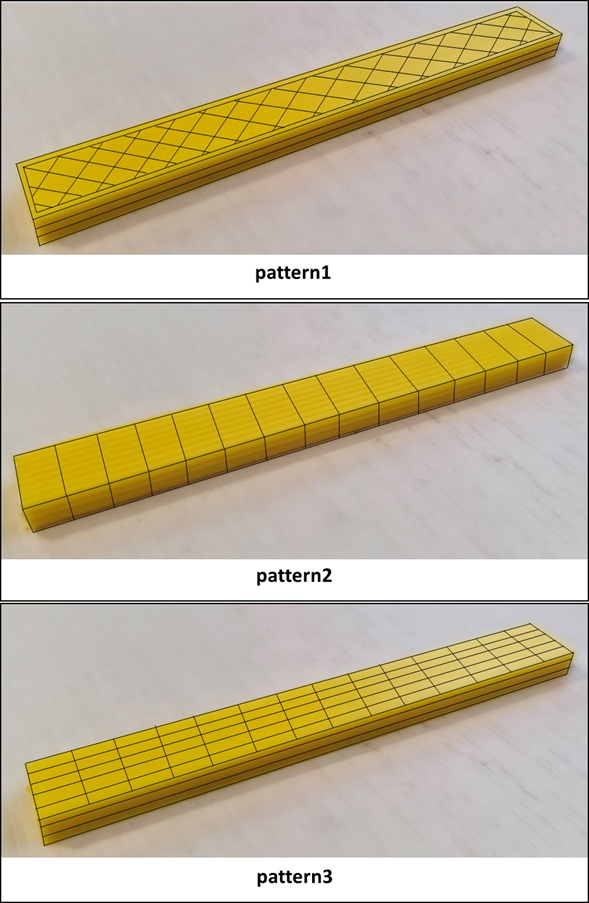
Common (Shape)
| Length | 80mm |
| Width | 10mm |
| Thickness | 4mm |
Common (Print Conditions)
- • Layer height:0.10 mm
- • Nozzle diameter:0.40 mm
- • Print speed:50 mm/s
- • Bottom layers, top layers, and perimeter walls:None set(No perimeter shells, entire cross-section composed of infill only)
- • Infill:100% (hatch pattern)
- • Post-processing:None performed(No additional sanding or surface treatment after fabrication)
By Pattern
To compare differences due to layer direction, test specimens of the same shape are fabricated in the following three patterns.
- Pattern 1:Longitudinal direction and layer direction are collinear
The longitudinal direction of the test specimen is placed horizontal to the bed surface, and printed so that the fabrication lines (layer lines) are in the same direction (parallel) as the longitudinal direction.
- Pattern 2:Layer direction placed diagonally to longitudinal direction
The longitudinal direction of the test specimen is placed horizontal to the bed surface, while the layer lines are printed diagonally to the longitudinal direction (e.g., tilting the layer direction at an angle around 45°).
- Pattern 3:Print with longitudinal direction vertical
The test specimen is printed in an upright position with the longitudinal direction perpendicular to the bed surface. This is the most severe orientation for interlayer direction against bending load.
* Black lines in the photo indicate print direction (orientation during fabrication). Pattern differences are organized as the relationship between this orientation and layer direction.
Measurement Method
The bending strength test on this page is a simple evaluation for the purpose of "comparing test specimens fabricated under the same conditions." It is not a measurement that fully follows strict test standards in a dedicated test room, but is positioned as an experiment within the range possible in a home environment.
The external dimensions of the test specimen (thickness, width, etc.) are assumed to be as set during modeling, and dimensional measurements of individual test specimens are not performed before testing. Therefore, the values shown here should be treated as "comparison of bending strength when calculated based on design dimensions."
Regarding the test environment, it is not an environment where temperature and humidity can be controlled with dedicated equipment. Since testing is conducted in a home workspace, room temperature and humidity depend on the environment at the time. While extreme changes due to air conditioning or dehumidifier on/off are avoided, please note that this is not a strict environmental test.
Measurements are basically performed using three test specimens fabricated under the same conditions. The maximum load of each is recorded and treated as reference values for confirming trends.
Note that on this site, standard deviation and statistical variation evaluation are not performed. Also, detailed observation of fracture surfaces and classification of failure modes are not conducted, and data is published here for roughly comparing "which conditions/materials seem relatively stronger."
Formula
Flexural strength σ = 3FL / (2bh²)
- F: Maximum load (N)
- L: Support span (mm)
- b: Specimen width (mm)
- h: Specimen thickness (mm)
Cautions
Important:The measurement results on this site are not intended for use as a basis for academic research or product design. Please view them as reference data within the scope of personal interest and verification.
For strict material testing, measurement at a testing institution compliant with JIS or ISO standards is recommended.
Test Overview Diagram
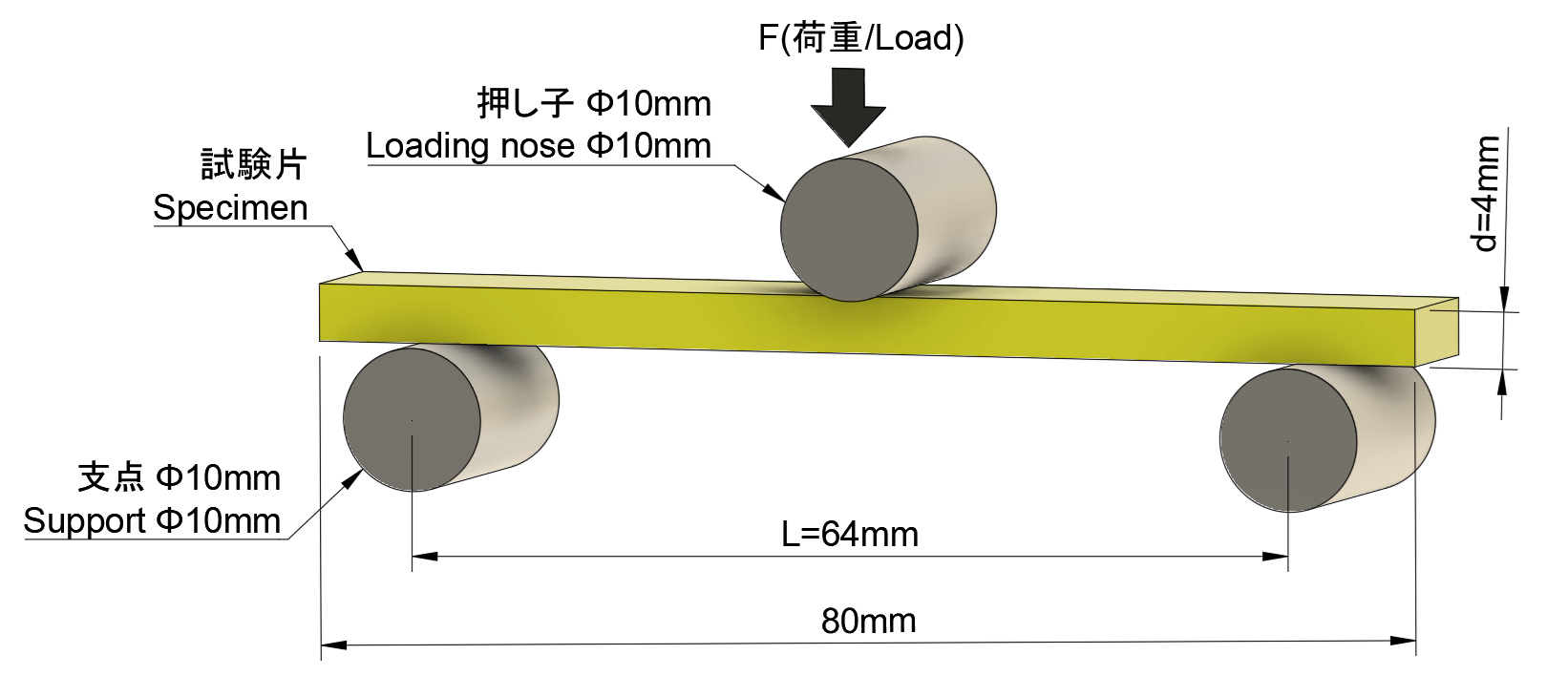
Basic configuration of three-point bending test: Support specimen at two points and apply load from center
Reference Standards
• ISO 178: Plastics - Determination of flexural properties
• ASTM D790: Standard Test Methods for Flexural Properties of Plastics
• JIS K 7171: Plastics - Determination of flexural properties
About Data Usage
Personal use is free, but please contact us before public disclosure
Test data published on this site (flexural strength, stress-strain curves, CSV, etc.) is free for personal material selection and learning purposes. However, if you publish on videos, articles, SNS, etc., or redistribute data, please contact us in advance.
For details, please see Data Usage Policy.